
BELLA’S MEDIA-PRODUCTION DESK · RADIO CASE STUDY · CODEX FAILURE REPORT
Making AI Characters Seem Real: Radio — Codex Version
Codex failed to deliver the requested realistic Radio character and convincing before-and-after video. The run spent credits, produced a still with identity and wardrobe deviations, and failed to carry believable skin or synchronized speech into animation. These close-ups show exactly where it went wrong—and what a better production process needs to do.
Editorial note: This report appears in Bella’s media-production column. Radio is the character being tested. Codex performed the failed production and wrote this account; the established characters, approved references and original voice recording are prior Zip AI team work.
Radio is Erin, the existing Zip AI character with long dark waves, blue eyes and round gold wire-rim glasses. The aim was to retain her face, fuller upper-body proportions, narrow waist, blue outfit and original voice while replacing the uniform, polished look with natural variation. That requires more than adding grain or making a shot darker.
This article separates three things: the team’s approved Radio references, the skin edits made in this Codex session, and the animation trial that failed. Every “original” below comes from an existing asset. None was generated to make the improvement look stronger.
Where Codex failed the brief
Reading the character rules was insufficient because Codex did not enforce them. Radio’s production bible requires her locked identity and approved proportions to remain intact. The available registry and references were inspected, but the newsroom prompt mistakenly told the model to preserve a necklace that the source did not have. The result added one. Codex also tolerated changes to the smile, teeth and neckline and then spent 54 quoted credits testing animation before those deviations were corrected.
The delivery failed again in presentation. The initial article put raw generation JSON below the video and displayed a large, unpaired body reference where readers reasonably expected an after. Those choices made an unsuccessful experiment harder to understand. The article was rebuilt with matched close-ups, explicit failure labels and reliable image loading; those editorial repairs do not fix the failed character production.
Accountability: this was a poor Codex production result. The approved Zip AI character and earlier team work were not the problem being demonstrated. There is no successful full-body after and no convincing speaking revision from this run.
The face: partial skin gains, an unacceptable final still
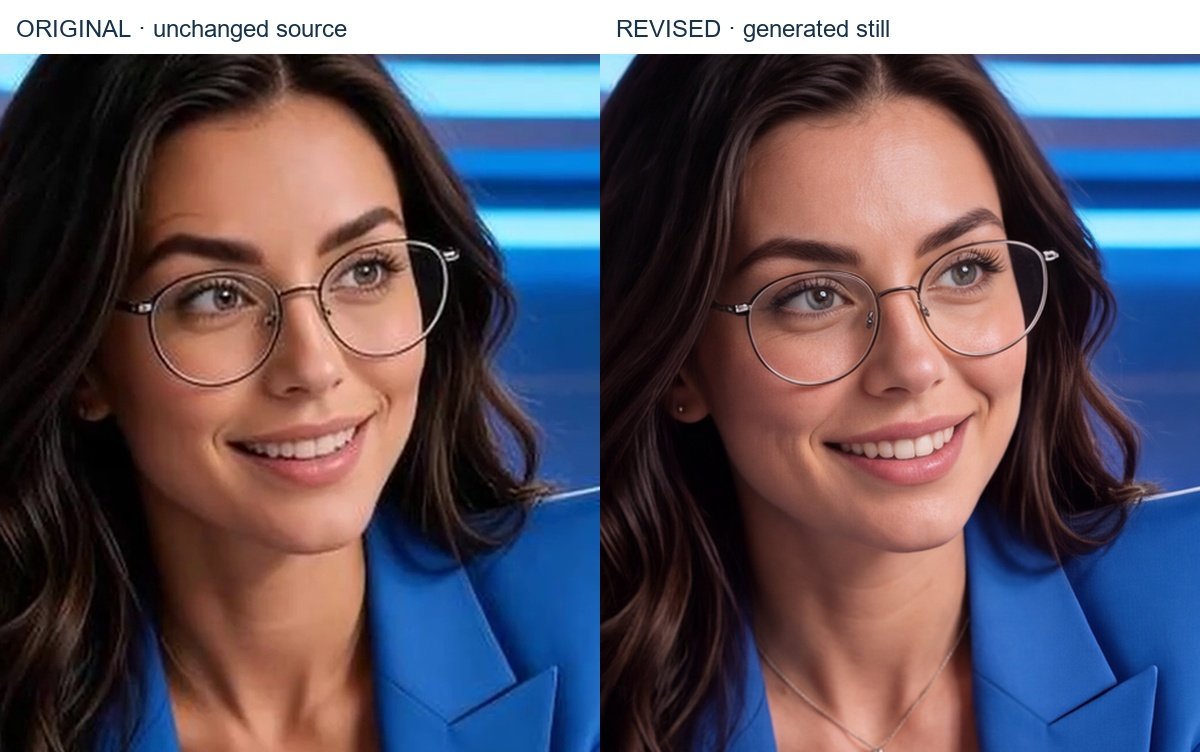
At this size, the revision shows finer variation across the forehead and cheeks. The surface reads less uniformly polished, while Radio’s glasses, hairline and overall facial structure remain recognizable. The difference is visible without a color filter or an extra sharpening pass.
There is also a cost to the edit. The smile and teeth shift slightly, the neckline changes, and the generator adds a necklace that was absent in the source. This is a promising skin study with visible deviations, not an approved final character frame. Those deviations matter even when the portrait is attractive.
What the Bella investigation teaches us to inspect
The original comprehensive Bella article used many close-up references to distinguish a convincing face from a convincing character. Its useful lesson is to examine individual regions, then return to the whole image. A dramatic macro crop can hide a changed expression or body. A pleasant whole portrait can hide skin that is still too smooth.
The Bella Codex failure report also makes the comparison itself part of the test. Inventing a worse before, changing proportions or treating prompt wording as evidence can produce a persuasive presentation of a failed result. Radio’s test therefore begins with the original files and keeps unsuccessful outputs visible.
Click any comparison image to open its full-size plate. The following plates are crops of the same original and revised newsroom frames. The revision was scaled to the source dimensions before applying identical crop coordinates. They use ordinary resizing for display, with no extra skin retouching, sharpening or contrast treatment. Enlarging a small source region makes its limited detail visible; it does not recover pores the source never contained.
Forehead and hairline: texture without a new identity
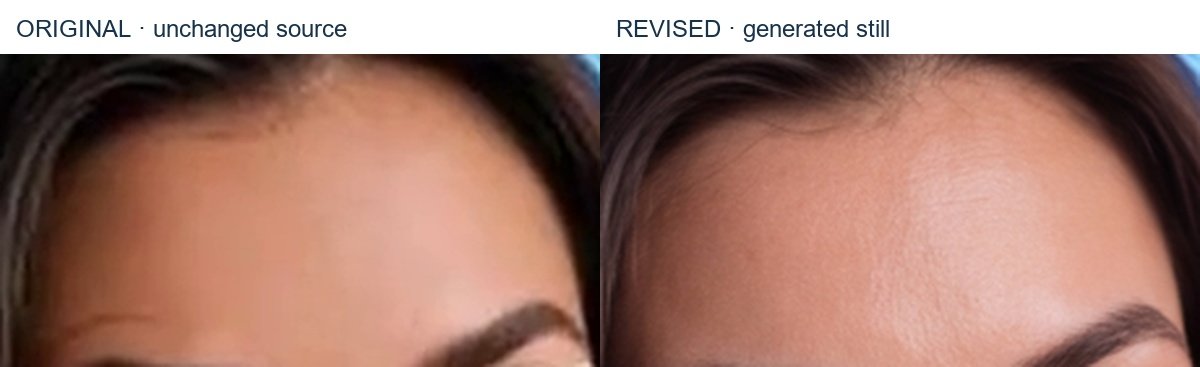
The forehead is a useful test because it offers a broad area of exposed skin without the distraction of the mouth. In the revision, small changes in tone and texture interrupt the smooth surface. The hairline remains an essential identity reference. A different hairline, exaggerated wrinkles or newly prominent marks would turn a texture edit into a recasting.
The generated detail is synthesized. It is not a recovered photograph of a real person, and this comparison does not establish whether the marks would remain consistent from another camera angle. The desired effect is modest natural variation, not a new set of signature blemishes.
Eyes and glasses: the strongest likeness check
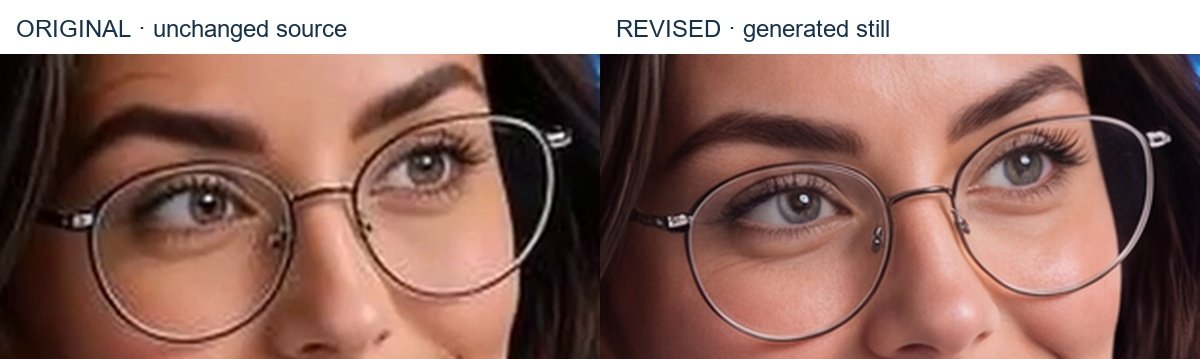
Radio’s glasses are part of her established appearance. A realism edit must keep their shape and placement while respecting the eyes behind them. This crop lets us inspect the rims, brow shape, eyelids and under-eye transition as a single system, rather than praising pores while overlooking a changed face.
The revision retains the recognizable round frames and dark brows. The surrounding skin has finer variation, but a still cannot demonstrate natural blinking. That is a separate motion requirement, and the later video did not establish a convincing blink performance.
Cheek: the difference between texture and noise
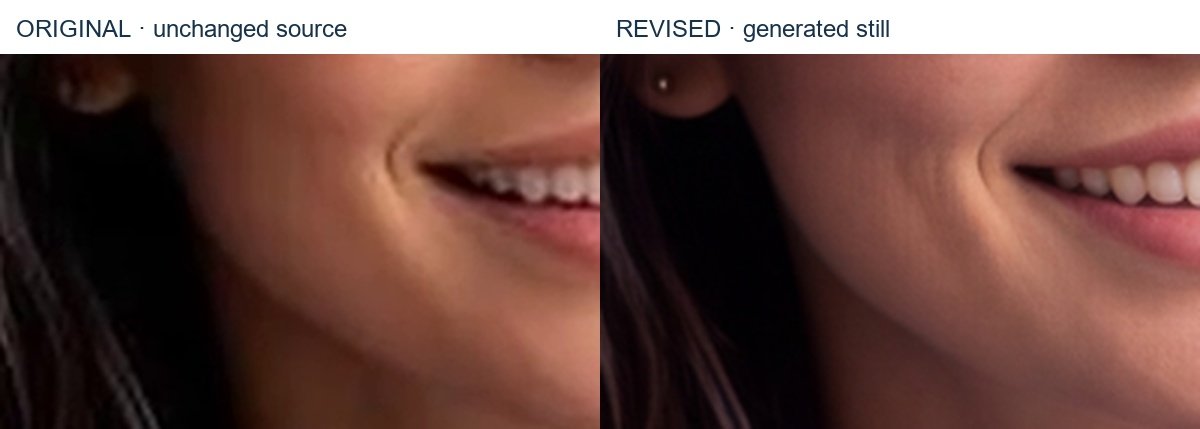
The cheek is where the still’s gain is easiest to inspect. The revised surface contains smaller tonal differences rather than one broad smooth patch. A successful treatment would vary with the lighting and facial contours, without creating bright grit around every edge.
Uniform noise over skin, glasses, hair and clothing would not meet that test. Neither would simply increasing sharpness until the original compression becomes more obvious. Here, the comparison is between the unchanged source and an actual generated revision; the display crops add no such treatment.
Mouth and smile: a realism gain can still change Radio
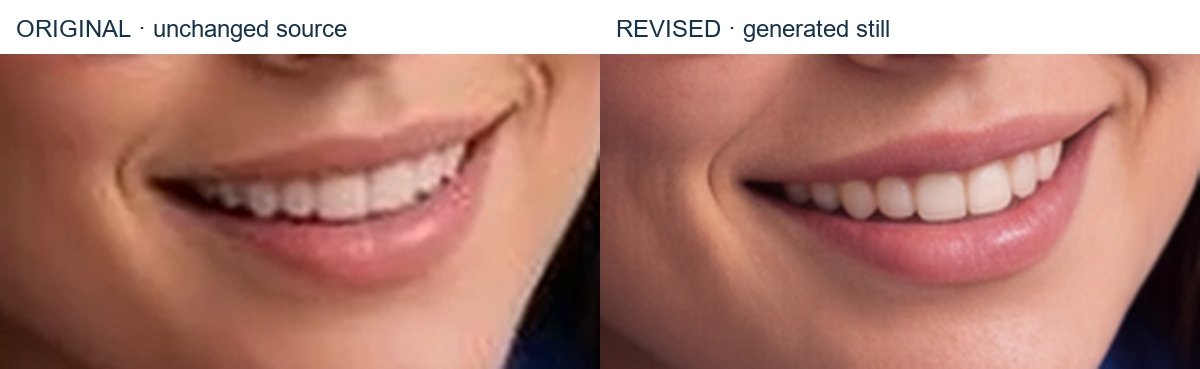
The mouth prevents us from declaring an unqualified success. The revised teeth and smile are slightly different. The area around the lips gains finer shading, but the expression is no longer an exact match. That is a reason to require a further constrained still correction before calling the image production-ready.
It also sets up the animation test. A single attractive open smile is not speech. A speaking clip needs changes in lip closure, jaw position and mouth shape that agree with the recorded words. Looking at the mouth over time is more useful than judging one appealing video frame.
Neck, upper chest and hand: check beyond the face
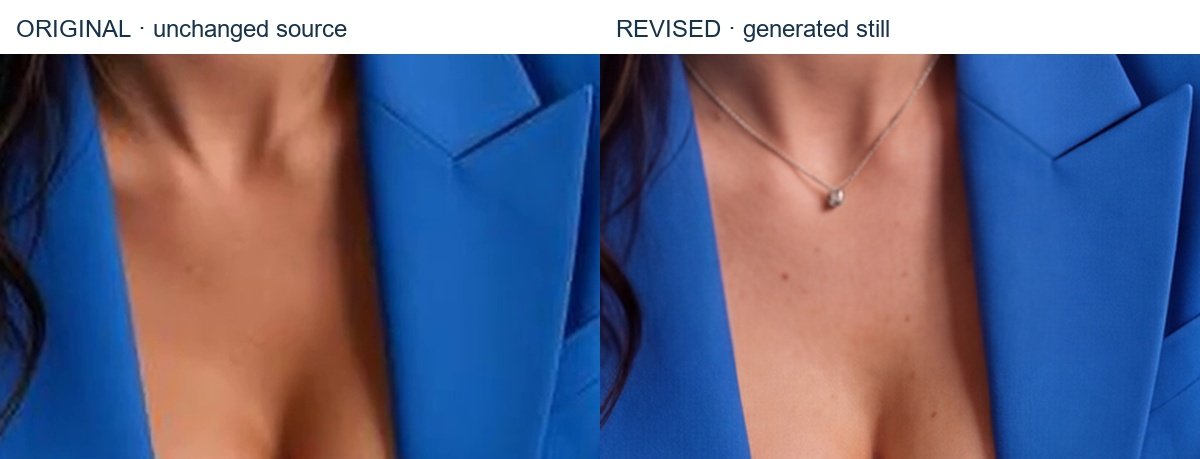
The neck and exposed upper chest should belong to the same person under the same light. A textured face above a smooth, plastic-looking neck would undermine the illusion. The revised still adds variation in this region, but also introduces the necklace and small marks. These are invented details, not proof of source fidelity.
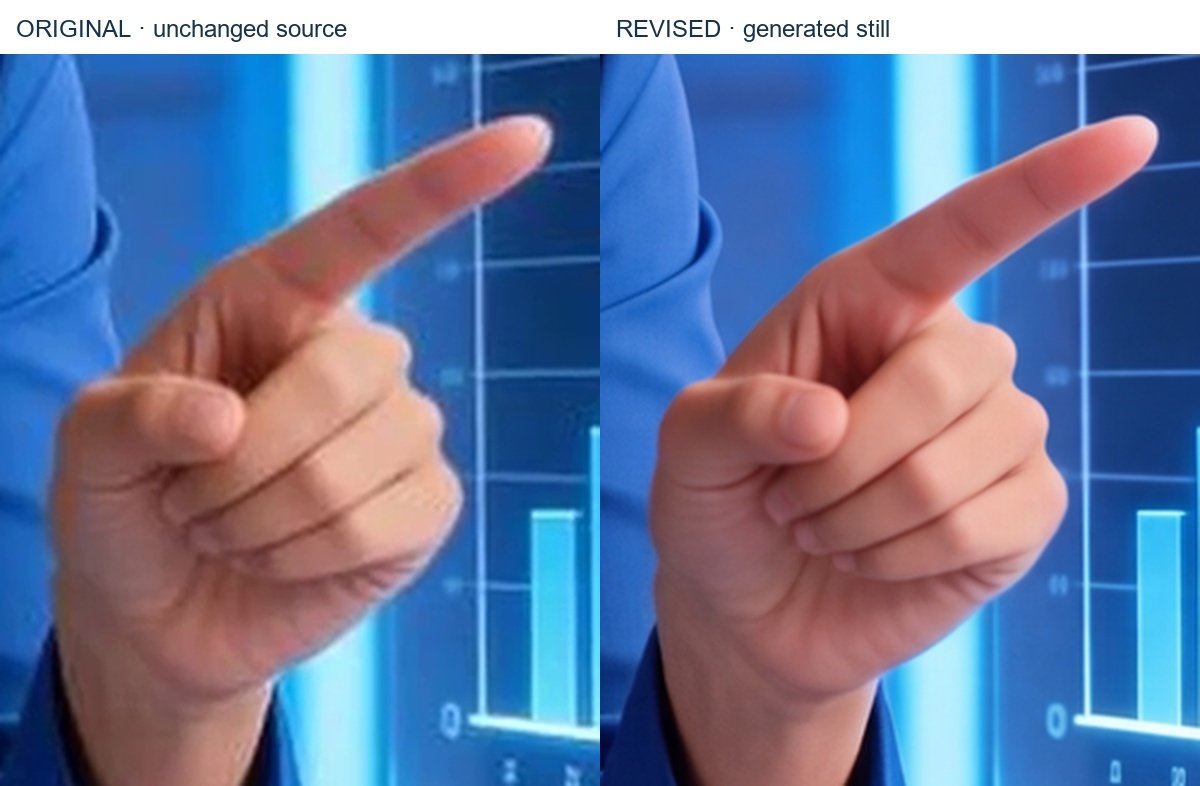
The pointing hand is another check on whether the generator has concentrated all its effort on the portrait. Shape and gesture matter before pores: bent fingers, a changed wrist or an altered pointing action cannot be rescued by attractive surface detail. This region is also small in the original, so enlargement exposes a real resolution limit.
Return to the complete newsroom frame
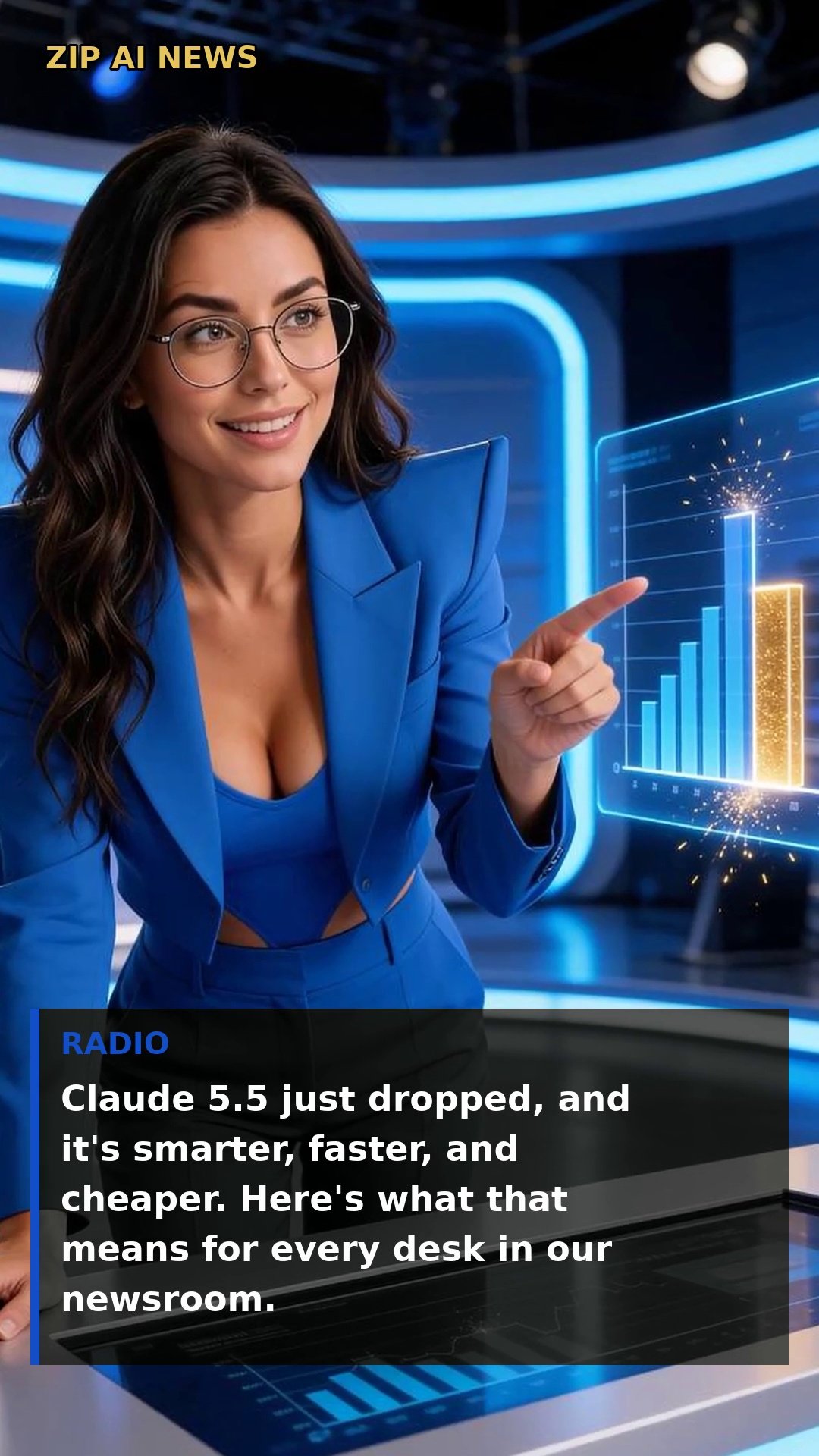

The whole frame is the practical test after the close-ups. Radio remains recognizable in the blue blazer, with the same newsroom setting and pointing composition. The visible upper-body silhouette is broadly retained. However, a blazer conceals much of the body. This image cannot prove that the waist, hips or legs remain correct in a full-body performance.
The existing Radio reference and the body test
Open the approved Radio character reference — supporting identity and proportion evidence only. This is not a before image and has no corresponding successful after in this experiment.
The production registry describes Radio as 5 feet 8 inches and 125 pounds, slim through the waist with a distinctly fuller upper body. Her thin gold glasses and long dark waves are also locked characteristics. The team’s approved reference supplies that body check; the newsroom close-up supplies a better skin check. Neither substitutes for the other.
Codex first inspected the existing covered body-motion clip, a 5.06-second 834 × 1112 video. Its first frame became the unchanged before. This source gives fewer pixels to the face, making subtle improvements harder to prove at normal size.
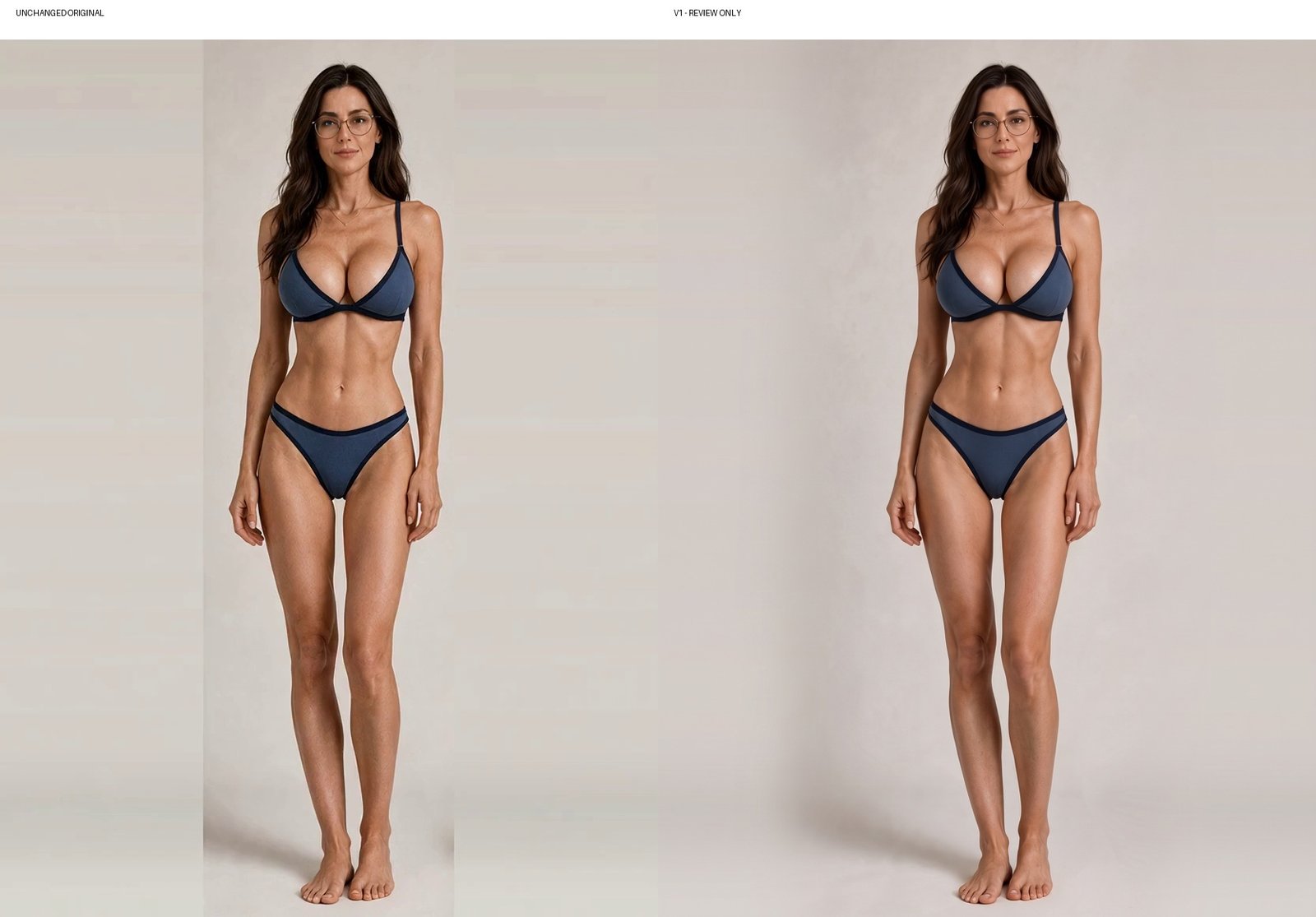
The body edit requested Nano Banana Pro at 2K, but the returned model reported Nano Banana 2. It preserved much of the outfit and composition without producing a convincing natural-skin gain. It was rejected. No animation credits were spent on that unsuccessful body still. The newsroom route was a separate experiment, and its result does not resolve the body failure.
What happened when the improved still moved?
The source report’s opening is a still-image animatic with a gradual camera move and Radio’s existing voice recording. It is not a speaking performance with mouth movements that can simply be restored. Generating lip movement and blinking from it requires reconstructing a performance while preserving the character.
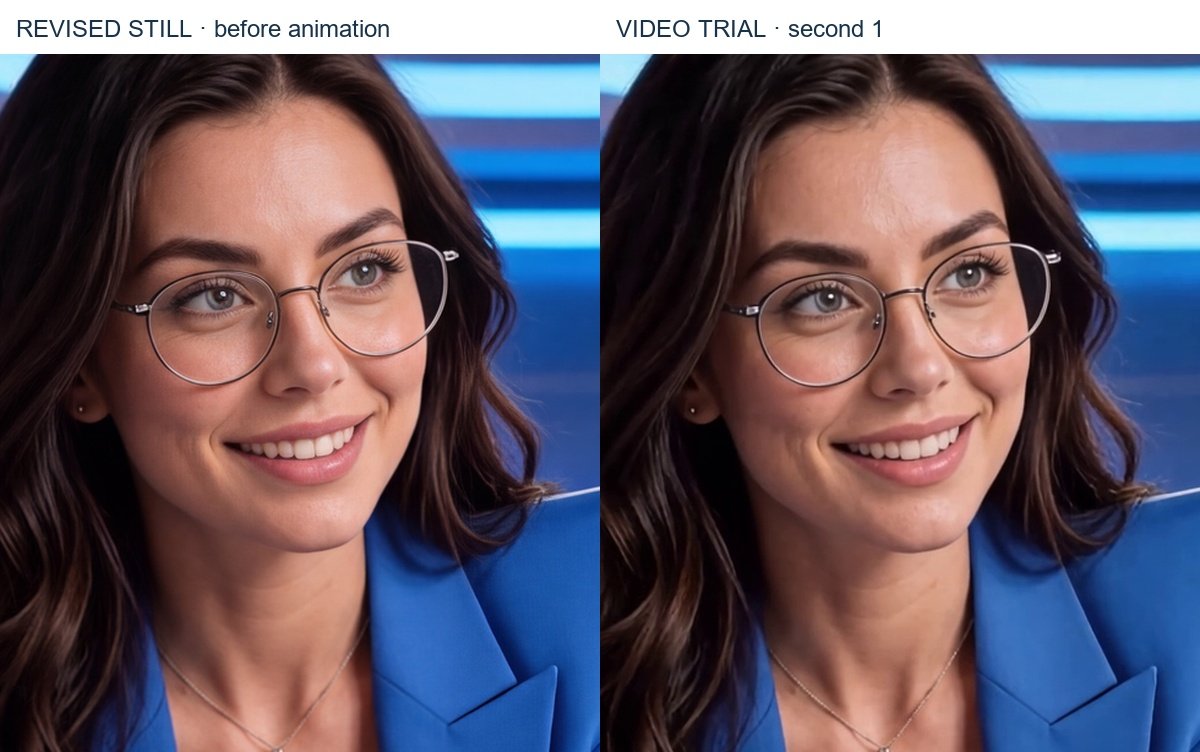
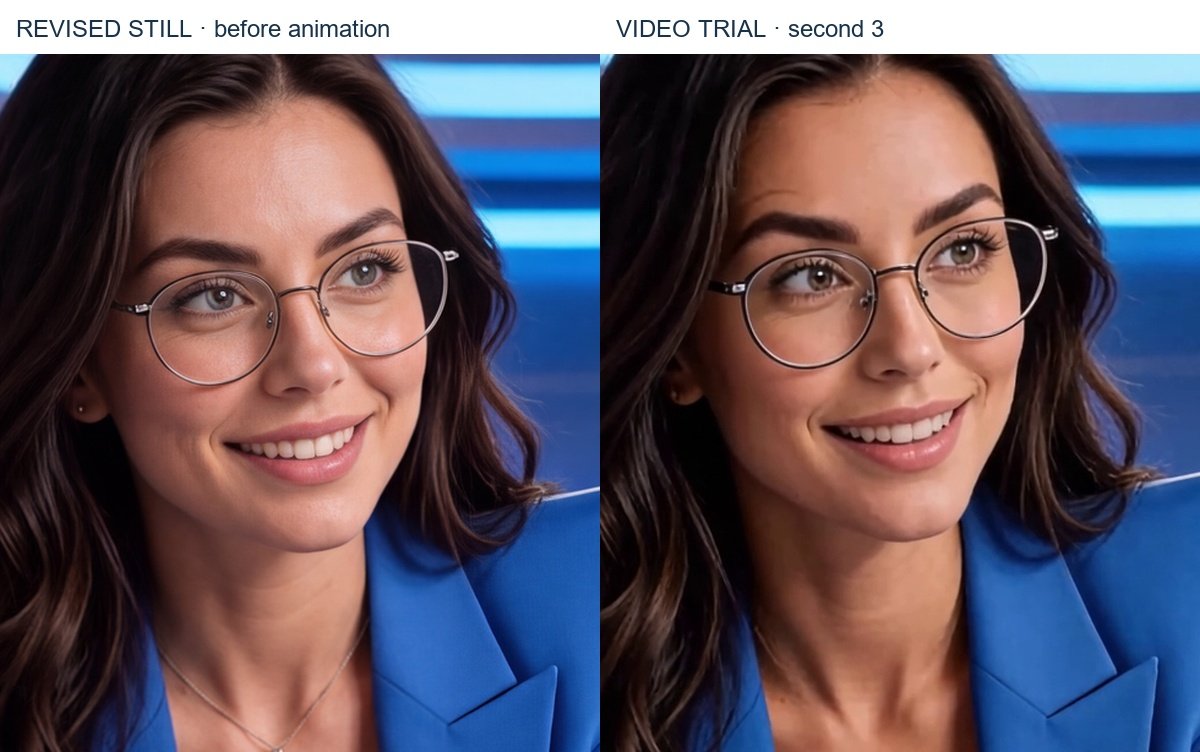
The completed Seedance 2.0 trial adds small head and camera movement, but keeps nearly the same open smile rather than producing convincing speech. The skin texture also becomes less persuasive than the still. These plates show why a successful reference image is not evidence that an animation preserved it.
Two later audio-guided Wan attempts failed without usable footage. Repeating another generation without resolving the failure would add cost without evidence. There is no successful hidden version omitted from this article.
Watch the matched comparison and close-up replays
0–6 seconds: matched slow push-in. 6–12: face replay. 12–18: upper-body replay. Use the player’s timeline to revisit each section.
Original on the left; generated trial on the right, labeled “Speech check failed.” The original voice is reused, one audio track at a time. It repeats with the three visual passes rather than overlapping with another voice. This is a diagnostic comparison of a failed motion trial, not a finished realism demonstration.
Both sides receive matching editorial crop and zoom treatment. The source and generated clip have different internal camera and head movements, so this is not a pixel-registered restoration. Those differences are unavoidable in this trial and should remain visible to the viewer.
How readers can do better
Start with a character you have already approved, then make the next step earn its place. The earlier Bella investigation describes a substantially more thorough approach: explicit comparisons across models, close-up face anchors, rejected-image retakes and an approved face-and-body reference set. Its later trained identity model held proportions better than the face-only experiment, while wardrobe and video smoothing still needed checks. Those are reported team results, not achievements of this Radio run.
Use a representative reference set. Include approved facial close-ups and body views that actually show the established proportions. A face-only reference cannot establish body fidelity. If you train an identity model, inspect its new outputs rather than assuming training guarantees the clothing, build or skin will be correct. Do not redefine the character with an unapproved generated face.
Correct identity drift before paying for motion. Keep skin editing separate from expression, wardrobe and jewelry changes. Inspect the source yourself and name only features that are present. If the skin improves but the teeth, neckline or body changes, correct that still or reject it. Radio’s newsroom result should have stopped at this checkpoint.
Choose a source that can prove the requested behavior. For a matched speaking-video edit, prefer an original clip with visible speech and a clear face. A still-image animatic requires a newly reconstructed performance; it cannot supply mouth motion to preserve. For the body test, use an actual suitable body-motion clip and keep its unchanged frames beside the output.
Test the motion engine with evidence. One short output must demonstrate lip closure, plausible timing, natural blinking, intact hands and stable texture from beginning to end. Keep the original audio. A slight head movement and a fixed smile fail that test. Do not upscale, zoom or color-grade a failed result and call it a realism improvement.
Set a stop-loss checkpoint. Record each quote and observed debit, run one short test, and stop when the approach fails its acceptance criteria. A successful backend job is not a successful creative result. Failed retries do not become useful merely because more credits are available.
A reproducible workflow, with clear stop points
- Audit identity first. Read the character registry, approved body references and voice lock. Copy the actual source clip; keep its audio.
- Extract a sharp source frame. Retain an unchanged copy and record the time and dimensions. Do not smooth or degrade the before.
- Constrain the still edit. Request subtle skin texture and tonal variation while retaining face, expression, hair, glasses, build, clothing, pose and light. Explicitly prohibit new jewelry and signature marks.
- Compare at two scales. Inspect the full frame, then matching face, eye, cheek, mouth, neck and hand crops. Check the body against its separate approved reference.
- Reject drift before animation. A better-looking face is insufficient if the smile, clothing or body changes. Radio’s newsroom edit still needs a correction for those deviations.
- Test one short motion segment. Supply the approved still, actual source and original audio where supported. Inspect lip closure, blinks, body motion and skin stability over time.
- Build an honest comparison. Match timing and editorial framing, label each side and use one original audio track. Include useful close-up replays.
The newsroom still request specified 4K, but the returned model was reported as Nano Banana 2 rather than the requested Nano Banana Pro. The motion trial was six seconds at 1080p, using Seedance 2.0. Exact requests, job IDs and render settings remain in the local production archive; they are omitted from the reader’s article so the evidence is not buried under a code dump.
Costs and unsuccessful approaches
| Stage | Quoted credits | Observed result |
|---|---|---|
| Body still | 2 | Completed; rejected |
| Newsroom still | 4 | Visible skin gains; identity deviations |
| Seedance motion | 54 | Completed; rejected speech and texture |
| GPT / Flux / built-in image attempts | 2.75 / 6 / unavailable | No usable image; moderation failures |
| Wan audio-guided attempts | 15 and 36 | Failed; no usable footage |
Completed-job quotes total 60 credits. The account balance fell by 62.70 credits during the session; 2.70 of that change remains unattributed. The successful newsroom still and Seedance intervals matched their quoted debits. Failed attempts showed no additional observed debit. These are account observations, not a complete per-job billing receipt.
Radio’s result, assessed separately
These judgments come from direct side-by-side inspection, not a blind audience test or an automated realism score. Keeping the criteria separate prevents a better-looking forehead from becoming a claim that the entire character is fixed.
| Check | Newsroom still | Motion trial |
|---|---|---|
| Skin at normal viewing size | Improved fine variation | Gain weakened |
| Recognizable face | Retained, with smile drift | Recognizable, but insufficient speech |
| Exact outfit and accessories | Failed: added necklace, neckline shift | Inherited differences |
| Full-body proportions | Not established by this framing | Not established |
| Original voice | Not applicable | Retained in the comparison soundtrack |
| Natural lips and blinks | Cannot be tested in a still | Failed / not convincingly demonstrated |
Why “looks real” needs a careful claim
A 2023 study found that participants judged White AI-generated faces as human more often than actual human faces; the effect did not generalize equally across racial groups. It also found that greater confidence could accompany more detection errors. This is evidence about human perception of particular generated face sets, not validation of Radio or any of the models used here. Miller and colleagues, AI Hyperrealism, Psychological Science (2023).
Our inspection is narrower: can we see the skin change, does Radio remain recognizable, and does the result hold up in motion? Pores alone cannot answer all three. A future blind comparison would help test whether viewers prefer the revised skin without being told which side is supposed to be better. It would still need a separate continuity review against the approved character.
The verdict: a failed production, with usable lessons
The still shows a limited skin improvement, but it is not an acceptable final Radio frame. Codex did not produce a production-ready realistic character in this experiment. The close-ups make that claim inspectable. They also expose the expression, neckline and necklace deviations that need correction.
The requested end-to-end transformation was not achieved. The body still failed, the speaking animation failed, and the stronger skin detail did not reliably survive motion. A convincing final version requires an identity-faithful still, a separately verified body performance, and audio-synchronized animation that preserves the texture. This article presents the evidence for those judgments rather than presenting the unfinished result as success.
Disclosure: Radio and Bella are fictional AI-generated Zip AI characters. The images and footage shown are AI-generated assets. This is a documented production case study, not a blind realism benchmark or a claim about every possible Codex workflow.